
Why Copper Pipes Develop Pinhole Leaks in Colorado Homes
For decades, copper was considered the gold standard in residential plumbing. However, thousands of homes built between the 1960s and early 2000s across the Denver Metro Area—including Arvada, Golden, Englewood, Sheridan, and Centennial—are now experiencing widespread copper pipe failure. Homeowners frequently discover green crusting deposits along pipe joints, unexplained spikes in water bills, or damp drywall spots caused by microscopic perforations known as pinhole leaks.
The 3 Primary Mechanisms of Copper Failure
1. Pitting Corrosion & Chloramine Chemistry
Municipal water districts across the Front Range treat water with disinfectants, chloramines, and corrosion inhibitors. When combined with naturally fluctuating pH levels and dissolved mineral salts, localized electro-chemical cells form along the interior walls of Type M (thin-wall) copper. This pitting corrosion gradually eats through the metal from the inside out until high water pressure creates a pinhole blowout.
2. Velocity Erosion in Hot Water Recirculation Loops
In larger executive homes—such as those in Greenwood Village, Cherry Hills Village, and Castle Pines—continuous hot water recirculation loops run 24/7. When water velocity exceeds 4 to 5 feet per second, hydraulic turbulence scours the soft protective copper oxide layer, particularly at 90-degree elbows and tees. This mechanical erosion quickly wears copper walls down to paper-thin margins, causing sudden ceiling leaks.
3. Subterranean Concrete Slab Leaks
Many post-war mid-century ranches in Englewood, Littleton, and Wheat Ridge were constructed on slab-on-grade foundations with soft copper lines buried directly under concrete. Soil settlement, chemical interactions with concrete aggregates, and expansion/contraction friction wear holes through subterranean lines. Signs include hot spots on tile floors, continuous water meter spinning, and foundational moisture.
Slab Leaks: Overhead Bypass vs. Jackhammer Demolition
When a pipe ruptures under a concrete slab, traditional plumbing repair calls for jackhammering through finished tile, hardwood, and structural concrete to solder a single patch. This process is expensive, messy, and leaves behind an already-degraded subterranean pipe that will inevitably leak elsewhere.
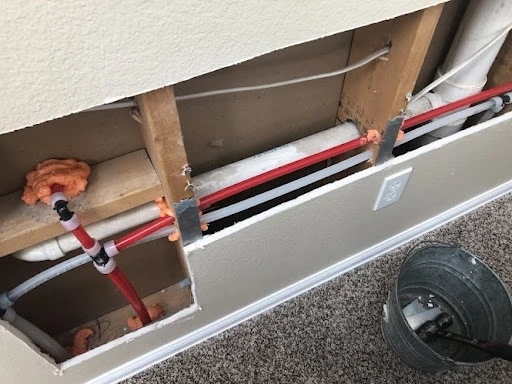
The Master Plumber Solution: Just Plumbing performs non-invasive overhead bypass reroutes. We permanently isolate and cap the failing underground line, routing fresh, scale-proof Uponor PEX-A expansion tubing overhead through wall cavities and attic spaces. Your slab remains undisturbed, your flooring stays intact, and the leak is resolved permanently.
Why Patching Copper Only Delays the Inevitable
Applying solder couplings, slip-fixes, or clamp sleeves to a pinhole leak fixes only a tiny section of a system that has deteriorated globally. Every time you solder near compromised copper, the heat from the torch weakens the surrounding brittle pipe. Once a home experiences two pinhole leaks, insurance underwriters view the property as an active flood liability.
Our whole-home repiping process completely replaces degraded supply networks with freeze-expanding Uponor PEX-A or commercial-grade Type L rigid copper. We complete installations in 1 to 2 days, maintain domestic water service every evening, and back our craftsmanship with a 25-year manufacturer material warranty and our 5-year workmanship guarantee.
Frequently Asked Questions — Copper Pinhole Leaks
What causes pinhole leaks in Colorado copper pipes?
Copper pinhole leaks stem from three primary causes: localized pitting corrosion from municipal water treatment chemicals (chloramines and pH swings), mechanical velocity erosion inside hot water recirculation loops, and chemical/friction reactions where subterranean copper contacts soil and concrete foundation slabs.
Should I patch a copper pinhole leak or repipe the home?
If your home has experienced two or more pinhole leaks, the interior copper walls have experienced widespread structural thinning. Patching single pinholes with solder couplings or clamps only redirects hydraulic pressure to adjacent weak spots, leading to inevitable repeat leaks inside walls and ceilings.
How does Just Plumbing repair a slab leak without jackhammering my floor?
We execute overhead bypass reroutes. Instead of breaking concrete and destroying tile or hardwood floors, we permanently cap and abandon the compromised subterranean copper line and route flexible, corrosion-proof Uponor PEX-A expansion lines through interior wall cavities and ceiling joists.
What warranty comes with a whole-home copper replacement?
All whole-home Uponor PEX-A installations completed by Just Plumbing include a 25-year manufacturer material warranty and our 5-year Master Plumber workmanship warranty.