The Challenge: A Hot Floor and a Spinning Water Meter
The homeowners of this slab-on-grade ranch in Arvada, CO noticed two alarming issues: their municipal water meter was constantly spinning even when all fixtures were off, and their dog refused to move from a strangely warm patch of newly installed custom hardwood flooring.
A thermal imaging scan quickly confirmed their worst fear: a subterranean hot-water copper slab leak. A franchise plumbing company quoted them an astronomical price to bring in jackhammers, tear up the $15,000 custom hardwood, break through the structural concrete slab, and solder a patch onto the compromised copper line. Desperate for a second opinion, they called Master Plumber Bill Clark at Just Plumbing.
The Master Plumber Diagnosis
Bill explained to the homeowners why jackhammering is almost always the wrong approach for a slab leak. When raw soft copper is buried in soil and concrete, it undergoes galvanic corrosion. Chemical salts eat away the exterior wall while thermal expansion forces the pipe to scrape against the concrete aggregate. A pinhole leak means the entire underground line is structurally degraded. Patching one hole guarantees another will blow out a few feet away within a year.
Instead of destructive demolition, Bill proposed an overhead slab leak bypass (a form of targeted partial repiping). We would permanently cap and abandon the leaking underground pipe, run a new PEX-A line up into the attic, and drop it down into the wall cavity to feed the bathroom—leaving the custom flooring 100% intact.
The 1-Day Bypass Execution
Step 1: Manifold Isolation & Abandonment
We located the origin of the leaking hot water line at the utility room manifold. We cut, capped, and permanently sealed off the subterranean pipe, instantly stopping the water loss and protecting the home's foundation from further washout.
Step 2: Overhead Uponor PEX-A Routing
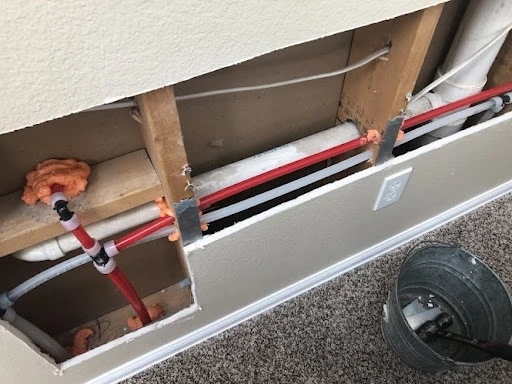
Instead of trenching the floor, our crew made small, strategic drywall incisions near the ceiling. We fished a continuous run of highly flexible, insulated Uponor PEX-A tubing up from the utility room, across the attic joists, and directly down the partition wall cavity to supply the master bathroom.
Step 3: Drywall Patching & Pressure Testing
With the new line secured via full-port ProPEX expansion fittings, we restored the water pressure. The new overhead line delivered flawless, silent flow. As always, Just Plumbing dispatched our professional drywall finisher the next day to patch, mud, and texture the access holes, leaving the walls ready for a quick coat of touch-up paint.
The True Cost of a Concrete Slab Excavation
When franchise plumbers talk homeowners into breaking up a foundation to fix a pipe, the plumbing quote is only the beginning of the nightmare.
The homeowner is left paying for concrete structural repair, asbestos testing (in older homes), dust containment cleaning, and the total replacement of luxury flooring that often cannot be color-matched. Our overhead bypass bypasses the headache, saving time, money, and your home's interior finishes.
The Outcome
In a single business day, the Arvada homeowners regained full hot water functionality. Their custom hardwood flooring was never touched, and the underground leak was eliminated permanently. The new Uponor PEX-A bypass line is backed by a 25-year manufacturer warranty, ensuring this specific leak will never happen again.
Learn more about our Targeted Partial Repiping Services, read about Why Copper Pipes Fail, or explore our Whole-Home Repiping Solutions.
Frequently Asked Questions — Slab Leaks
What causes a copper pipe to leak under a concrete slab?
When raw copper lines are buried directly in soil or gravel beneath a concrete foundation, they are exposed to chemical salts, moisture, and ground settlement. This creates a galvanic reaction that eats through the copper wall, combined with friction wear from the pipe expanding and contracting against concrete aggregates.
Why is an overhead bypass better than jackhammering the floor?
Jackhammering through a foundation destroys finished flooring (hardwood, tile, or carpet), requires expensive concrete patching, and only fixes one tiny section of an underground pipe that is already failing everywhere else. An overhead bypass abandons the bad pipe entirely and routes a permanent, flexible Uponor PEX-A line through the ceiling or attic with zero floor damage.
How long does a slab leak overhead bypass take to complete?
Unlike a full whole-home repipe, a targeted overhead slab leak bypass is typically completed by Master Plumber Bill Clark in just 1 business day, instantly restoring water service to your home.