
The Challenge: Nearly a Century of Plumbing "Band-Aids"
Like many properties in Denver's highly sought-after Washington Park neighborhood, this 1928 brick bungalow was architecturally stunning but mechanically crippled. Over the past 90+ years, various homeowners and un-permitted handymen had modified the plumbing. The result was a "Frankenstein" network of original tuberculated galvanized steel, original lead tub drains, and improperly sized thin-wall copper lines branching off to a second-story pop-top addition.
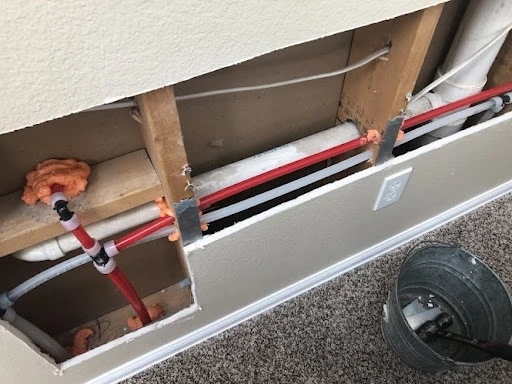
The primary complaint from the homeowner was catastrophic water pressure. If the dishwasher was running in the kitchen, taking a shower in the second-floor master suite was impossible. Furthermore, rust debris constantly clogged the modern, high-end shower valves they had recently installed.
The Master Plumber Diagnosis
Master Plumber Bill Clark mapped the home's water flow. The primary issue was that the entire second floor (added in the 1990s) was being fed by a heavily restricted 1/2-inch galvanized branch line tied into the first floor. A standard "branch-and-tee" repipe would improve flow, but it wouldn't fully solve the pressure drop when multiple fixtures ran at once.
Bill engineered a superior solution: a Home-Run Manifold System using Uponor PEX-A expansion tubing. Rather than chaining fixtures together, a central manifold block would act like an electrical breaker box for water. Every individual fixture in the home would receive its own dedicated, continuous, unbroken PEX line running straight from the basement manifold.
The 2-Day Execution
Day 1: Manifold Installation & Basement Routing
The team began by disconnecting and safely abandoning the century-old galvanized lines inside the walls. A heavy-duty Type L Copper main service header was built to feed the new Uponor PEX-A manifold. Flexible 1/2-inch PEX-A lines were routed across the open basement joists, feeding the main floor kitchen and guest bathroom. Domestic water was restored to these primary areas by the end of day one.
Day 2: Vertical Chases to the Second Story
To reach the second-floor master suite without destroying the home's original 1920s plaster, Bill and the team carefully fished the dedicated "home-run" PEX lines vertically through existing closet chases and behind built-in cabinetry. Full-port ProPEX expansion fittings connected the new lines directly to the luxury shower valves and vanity sinks. The system passed the City and County of Denver 100 PSI hydrostatic pressure inspection flawlessly.
The Home-Run Manifold Advantage
Why do we recommend home-run manifolds for multi-story homes?
Because each fixture has its own dedicated pipe connected to a balanced central chamber, pressure drops are virtually eliminated. If someone flushes a toilet downstairs, the shower upstairs doesn't lose pressure or scald the user. Additionally, every line has a dedicated shutoff valve at the manifold, allowing homeowners to isolate a single sink without turning off water to the whole house.
The Outcome
The transformation was immediate. The second-floor master bathroom shower pressure literally doubled, easily supplying the multi-head fixture even when the kitchen dishwasher was running. All rust and metallic tasting water vanished. As with all Just Plumbing residential repipes, our professional drywall patching team arrived the next day to seamlessly repair the small access incisions.
Learn more about the risks of Galvanized Steel Pipes, read about our Whole-Home Repiping Services, or explore another historic property in our Park Hill Case Study.
Frequently Asked Questions — Historic Repiping
What is a PEX home-run manifold system?
Unlike a traditional branch-and-tee plumbing system where fixtures share a single large pipe, a home-run manifold acts like an electrical breaker box for your water. A central manifold is installed near the water heater, and individual, dedicated Uponor PEX-A lines are run directly to every single fixture. This equalizes pressure across the entire home, so flushing a toilet no longer impacts the shower.
Is it safe to leave abandoned galvanized pipes in the walls of an older home?
Yes. Once the old galvanized or lead pipes are drained, physically disconnected from the water supply, and permanently capped, they are entirely inert. Leaving them in the wall cavities prevents unnecessary and expensive demolition of historic plaster and drywall.
Can you repipe a historic Denver home without destroying the original plaster?
Yes. By using highly flexible Uponor PEX-A tubing, our Master Plumber team can fish new water lines vertically through existing wall cavities, closets, and basement joists. We only make small, strategic access holes that are easily patched, preserving the home's historic architectural integrity.