The Hidden Decay Inside Post-War Galvanized Plumbing
Across older Denver Metro communities—including Park Hill, Washington Park, Berkeley, West Highland, Englewood, Edgewater, and Wheat Ridge—tens of thousands of post-war bungalows and mid-century ranches still rely on original galvanized steel water pipes. Originally coated with a thin dip of molten zinc to deter rust, these systems had an expected lifespan of 40 to 50 years. Having served for 60 to 90 years, every galvanized system along the Front Range is now well past its operational expiration date.
Primary Warning Signs Your Galvanized Pipes Have Failed
1. Crippled Water Pressure (Internal Tuberculation)
When the internal zinc coating dissolves, bare steel reacts with dissolved oxygen and minerals. Rust grows outward into dense mineral mounds known as tuberculation. Over time, a 3/4-inch main supply pipe constricts down to the internal diameter of a pencil, choking shower flow whenever a washing machine or garden hose runs.
2. Brown Water, Rust Sediment & Heavy Metal Leaching
If water comes out reddish-brown after vacations, or if faucet aerators constantly clog with black grit, your pipes are actively decomposing. Furthermore, pre-1960 zinc galvanization contained significant trace impurities of lead. As the zinc deteriorates, trapped heavy metals release directly into household drinking water.
3. Chronic Leaks at Threaded Joints
Threaded joints are the weakest link. Cutting pipe threads during original construction shaved away over 50% of the pipe wall thickness. These paper-thin grooves rust first, creating calcium stalactites, weeping joints in basements, and sudden wall bursts.
Why Galvanized Pipes Cannot Be Cleaned or Flushed
Homeowners frequently ask if chemical flushes or mechanical snaking can clear out internal rust nodules. The reality is dangerous: rust is often the only material holding the weakened pipe together.
Aggressive descaling chemicals or mechanical tools punch holes directly through paper-thin steel walls, flooding finished interiors. Full whole-home replacement is the only safe, permanent, and code-approved solution.
Historic Plaster Preservation During Whole-Home Repiping
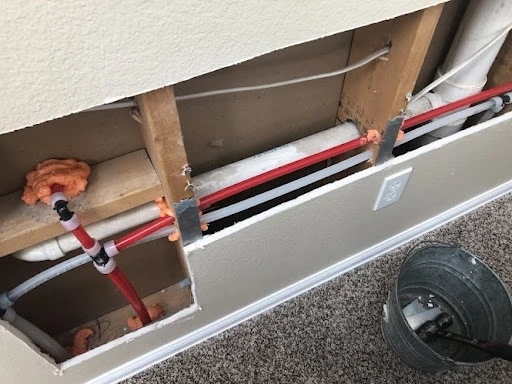
Older Denver residences feature historic lath-and-plaster walls, coved ceilings, and vintage wood trim that cannot be easily matched or patched. Traditional contractors make large, destructive trench cuts down entire wall lengths. Master Plumber Bill Clark executes non-invasive vertical feed routing.
We run flexible, scale-immune Uponor PEX-A expansion tubing (backed by a 25-year material warranty and our 5-year workmanship warranty) or rigid Type L Copper through unfinished basements, crawlspaces, and existing partition chases. In just 1 to 2 days, your home's water volume is restored to factory specifications without ruining historic architecture. See our direct craftsmanship in the Park Hill Galvanized Case Study and Wash Park Repipe Case Study.
Frequently Asked Questions — Galvanized Steel Replacement
Why is water pressure so low in older Denver homes with galvanized pipes?
Over decades of service, the interior protective zinc coating of galvanized pipes dissolves. Raw iron reacts with dissolved oxygen and minerals in municipal water, forming tuberculation nodules that choke the interior diameter down from 3/4-inch to the size of a pencil.
Can galvanized water supply pipes be chemically flushed or snaked?
No. Snaking or applying chemical descalers will puncture the severely thinned, brittle metal walls, triggering immediate wall flooding. Whole-home repiping with Uponor PEX-A or Type L copper is the only safe, permanent, and code-compliant solution.
Do corroded galvanized pipes pose drinking water health hazards?
Yes. Beyond releasing iron oxide flakes and giving water an unpleasant metallic taste, pre-1960 galvanized pipes frequently used unrefined zinc that contained naturally occurring lead. As the zinc layer breaks down, trapped heavy metals leach directly into household drinking water.
How do you repipe an older home without destroying historic plaster walls?
Just Plumbing utilizes non-invasive fishing techniques. We route flexible Uponor PEX-A lines vertically from open basements or crawlspaces through existing interior partition voids, avoiding destructive trenching across historic lath-and-plaster walls.