The Challenge: Brown Water & Dying Shower Pressure
A historic brick Tudor located in Denver's classic Park Hill neighborhood was suffering from extreme plumbing failure. The homeowners were unable to take a shower while the washing machine ran, discolored reddish-brown flakes settled at the bottom of the bathtubs, and calcium-rust buildup repeatedly choked faucet aerators throughout the house.
Multiple local plumbing contractors warned the homeowners that replacing their failing galvanized steel plumbing would require trenching through original plaster walls, coved ceilings, and vintage millwork. Reluctant to destroy their home's historic architectural value, the owners called Master Plumber Bill Clark at Just Plumbing, Inc.
The Master Plumber Diagnosis
During the diagnostic audit, Bill Clark tested dynamic water pressure at the exterior hose bib (82 PSI) versus the second-floor bathroom shower (a crippled 24 PSI when running). Upon cutting an inspection sample from the basement main header, Bill showed the homeowners that their 3/4-inch galvanized steel lines had suffered from severe internal tuberculation—leaving an internal opening no wider than a pencil point.
Bill engineered a non-invasive architectural routing plan: our team would abandon the corroded galvanized pipes inside the walls, utilizing open basement floor joists and vertical interior closet chases to fish flexible, scale-immune Uponor PEX-A expansion tubing directly up to fixtures without cutting into historic lath-and-plaster walls.
The 2-Day Restoration Timeline
Day 1: Water Entry, Mechanical Header & Main Distribution
After installing protective floor paper throughout the home, Bill began by cutting out the rusted meter transition. We installed a heavy-wall Type L Copper main service header, a calibrated pressure-reducing valve (PRV) set to 65 PSI, and a new thermal expansion tank on the water heater. We ran primary 3/4-inch Uponor PEX-A trunk lines along basement joists, establishing clean manifold zones for hot and cold distribution. Domestic water was restored to all fixtures by 4:45 PM.
Day 2: Vertical Chases, Fixture Risers & City Sign-Off
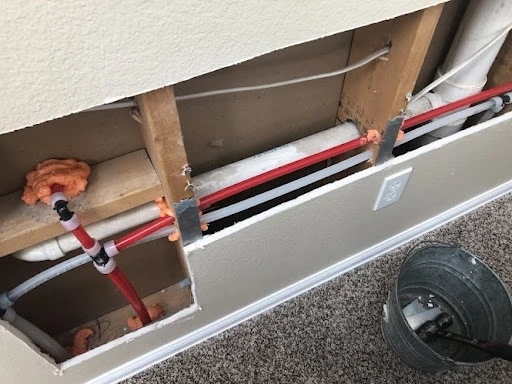
On day two, our crew fished 1/2-inch Uponor PEX-A branch lines up through linen closet floor cavities, connecting directly to shower valves, toilets, and vanity sinks using full-port ProPEX expansion fittings. Bill performed a 100 PSI air pressure test before the City and County of Denver plumbing inspector arrived. The inspector signed off on the permit with zero deficiencies.
Zero Damage to Historic Lath & Plaster
Traditional plumbing crews make large horizontal trench cuts across walls to pull rigid copper, cracking historic 1940s horsehair plaster.
Because Uponor PEX-A is extraordinarily flexible, our Master Plumber team pulled continuous single runs through existing vertical wall chases. The entire installation required only four small access incisions hidden inside closets and under vanity sinks. Our professional drywall/plaster finisher patched and textured these openings the following day.
The Transformation
Water flow to the second-floor shower increased by more than 200%, rust sediment was permanently eliminated, and the home's water is now completely lead- and rust-free. The homeowners received a 25-year manufacturer material warranty on their Uponor PEX-A system and our 5-year Master Plumber workmanship guarantee.
Read our technical guide on Galvanized Steel Deterioration, review our Whole-Home Repiping Services, or explore another Denver neighborhood project in our Wash Park Bungalow Case Study.
Frequently Asked Questions — Park Hill Galvanized Repiping
How did Just Plumbing repipe this Park Hill home without destroying the historic plaster walls?
Rather than making long horizontal trench cuts through brittle lath-and-plaster, Master Plumber Bill Clark mapped internal plumbing chases. Flexible Uponor PEX-A lines were fed vertically from the open unfinished basement ceiling up through closet interiors and existing pipe cavities, limiting wall cuts to small, strategic access panels.
What caused the severe drop in water pressure in this 1942 home?
Over 80 years of exposure to oxygenated municipal water, the internal zinc coating had dissolved completely. Heavy iron rust and calcium deposits (tuberculation) choked the original 3/4-inch galvanized supply pipes down to a channel narrower than a standard pen.
Did this repipe pass inspection with the City and County of Denver?
Yes. Just Plumbing pulled full municipal plumbing permits with Denver Community Planning and Development. The system passed the official rough and final hydrostatic pressure inspections on the first walkthrough.